The short answer
There is no single “hurricane-proof” rating for a pool enclosure. Every new, permitted enclosure in Brevard County is engineered to the Florida Building Code for the design wind speed at its address. Homes on the barrier island sit in the coastal wind-speed design zone and are designed for higher loads.
The numbers on the drawings only hold if the enclosure is built the way it was engineered. How the bracing is attached and what the fasteners are made of matter as much as the wind speed. We through-bolt our hurricane bracing.
What “hurricane-rated” really means
When a contractor calls an enclosure “rated for 150 mph” or “hurricane-rated”, what it should mean is this: the enclosure was designed by engineering for the wind speed the building code sets for that address, and it was built to those drawings.
Three things go into that design:
- Design wind speed. The Florida Building Code sets a design wind speed for every location. Brevard County publishes address-by-address wind speed maps.
- Risk category. Buildings are grouped by how much is at stake if they fail. Brevard County lists screen enclosures as Risk Category I, which sets the design wind speed used for them.
- Exposure. A home looking over open water or open fields catches more wind than one surrounded by other houses and trees. The engineer accounts for this.
The Florida Building Code is updated every few years; the 2026 edition is the ninth. The permits we apply for now are designed to the eighth edition (2023).
So a useful question for any contractor is not “what is it rated for?” but “will the engineered drawings be designed for my address, and will the build match them?”
Wind design across Brevard County
Brevard is a long, narrow county, and wind design changes from the mainland to the beaches. In broad terms:
| Where the home is | Examples | What it means for the design |
|---|---|---|
| Mainland, inland | Palm Bay, Viera, west Titusville, Port St. John | Designed to the mapped wind speed for the address. Surrounding houses and trees can mean a lower exposure. |
| On the Indian or Banana River | Rockledge, Merritt Island, riverfront Melbourne and Cocoa | Open water nearby can raise the exposure, so the frame may need heavier members or more bracing. |
| Barrier island | Cocoa Beach, Cape Canaveral, Satellite Beach, Indian Harbour Beach, Melbourne Beach | The coastal wind-speed design zone: higher design loads, and salt air that is hard on hardware. |
Your engineered drawings show the actual design for your home. We go over them with you before the permit is filed.
How an enclosure is engineered for wind
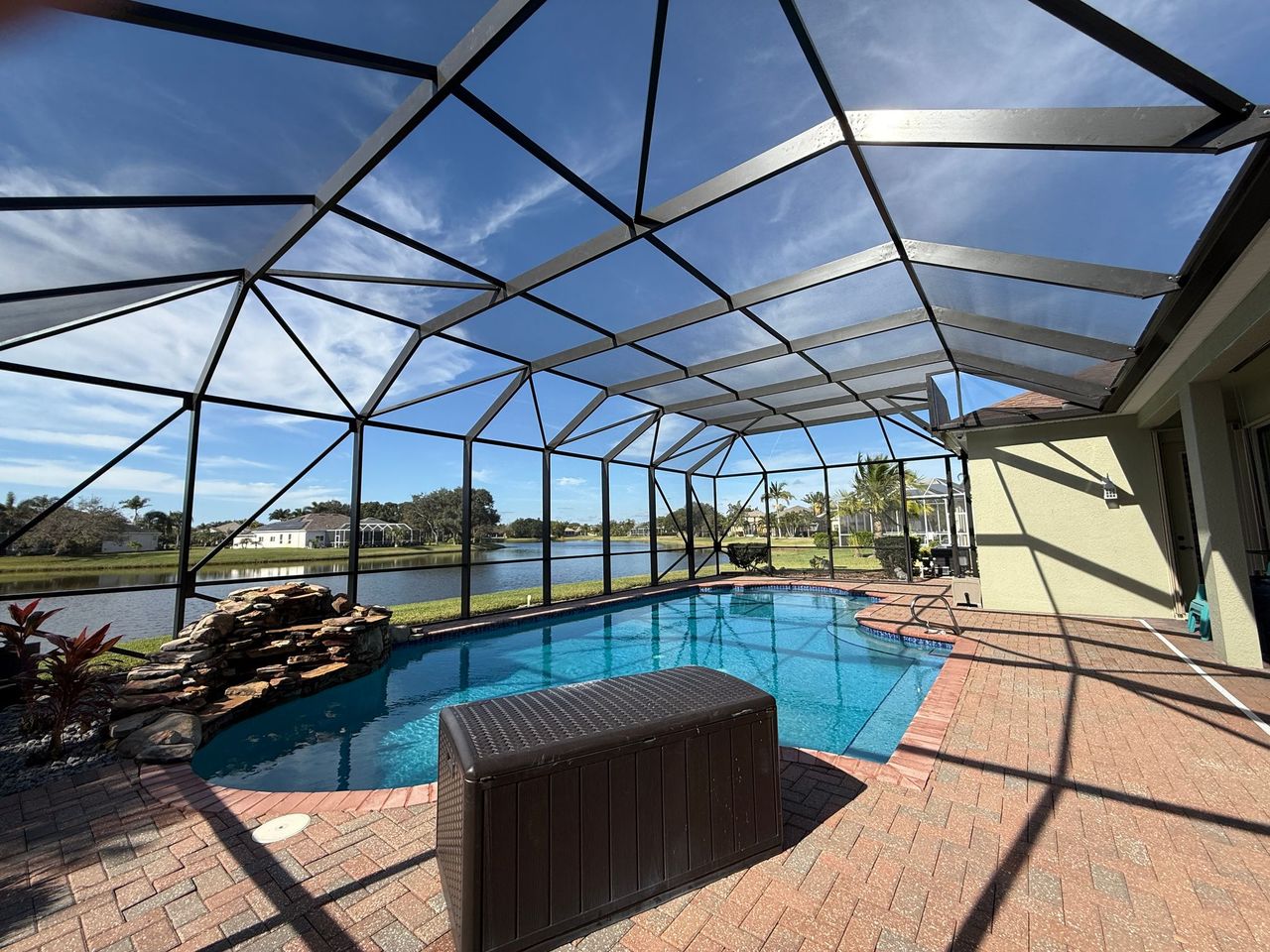
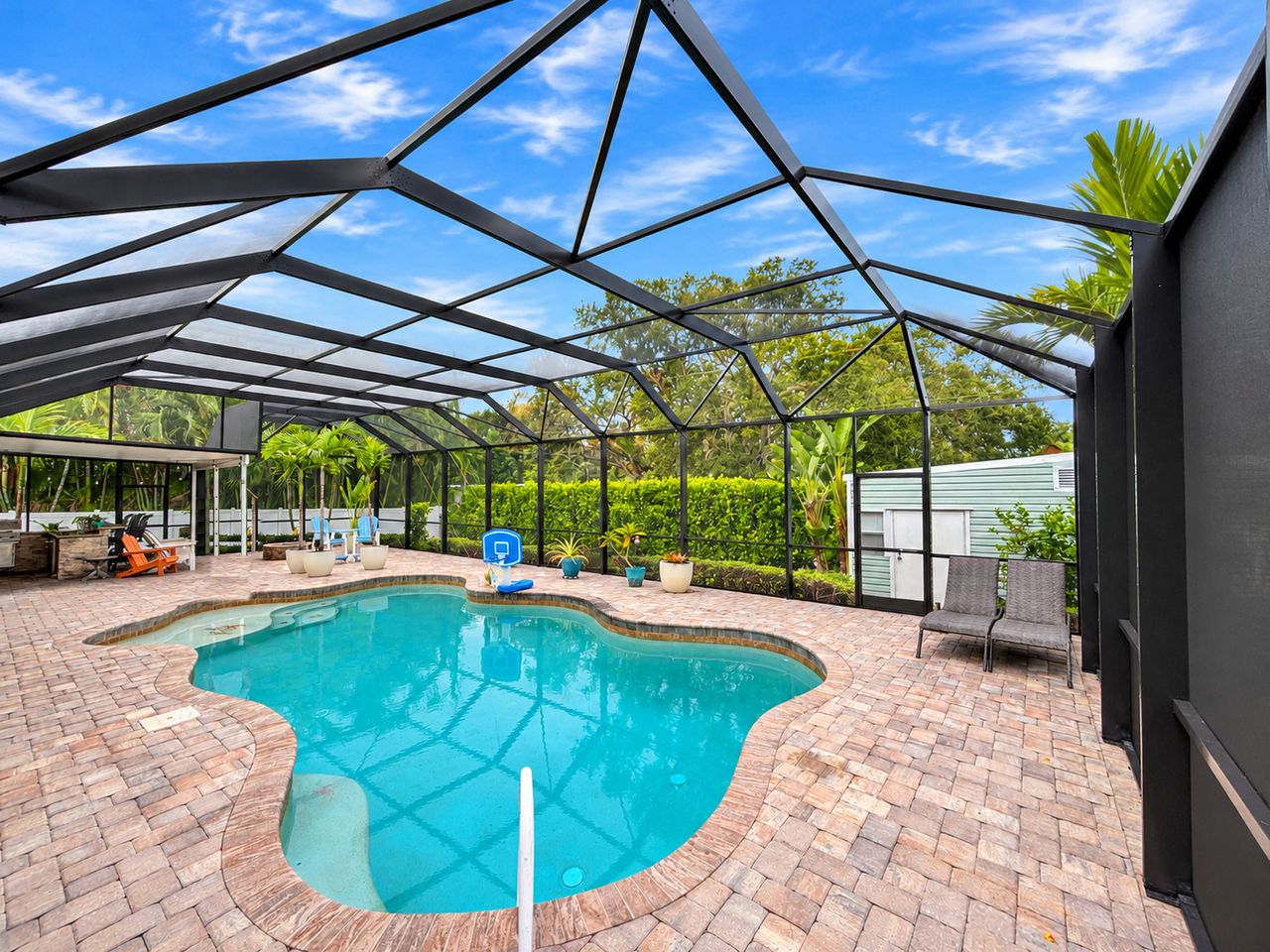
A pool enclosure is a big, light frame that catches the wind, and screen adds to the load. The engineering decides:
- the size and wall thickness of the beams, uprights and purlins
- how far apart they are spaced
- how the frame is braced against racking and uplift
- how every connection is made: bolts, brackets and angles
- how the frame is anchored to the footer and attached to the house
Aluminum screen enclosures are covered in Chapter 20 (Aluminum) of the Florida Building Code, and the engineering follows an accepted design method for aluminum in high-wind areas.
Our frames use Keymark aluminum, with Z-brackets, 2×2 wind bracing and 1/8-inch angles at the connections the drawings call for.
Through-bolted bracing versus screwed brackets
Wind bracing keeps the frame from folding sideways under a strong gust. How it is attached is one of the biggest differences between enclosures you can’t see from the street.
Through-bolted: a bolt passes all the way through the members and is held with a nut. The load is carried by the bolt across the whole connection.
Screwed with brackets: the bracing is fixed with screws driven into the aluminum. Screws in aluminum can loosen or pull out when the frame flexes back and forth in gusts, hour after hour, during a storm.
We through-bolt our hurricane bracing. When you compare quotes, ask each contractor how the bracing is attached.
Upgrade: K-bracing. On a screen-roof enclosure, you can replace the standard hurricane cables on the outside corners, which aren’t as strong, with K-bracing: rigid aluminum braces that stiffen the corners for better structural support in heavy winds. A Rockledge homeowner who is a structural engineer chose it for his lakefront pool enclosure. It isn’t used on enclosures with an insulated Structall roof.
Fasteners and corrosion
A frame is only as strong as its smallest parts. Ordinary steel screws rust, especially near the coast, and a rusted screw holds far less than a new one. Rust streaks at the joints are often the first sign that an enclosure’s connections are weakening.
We use 410 stainless steel fasteners, Xylan-coated and painted to match the frame, and we have used them for more than 20 years. We also replace rusty screws on existing enclosures, including the 1×2 channel around the base. See screen enclosure repair.
Is an older enclosure still safe?
The statewide Florida Building Code took effect in 2002, and wind design has been tightened in later editions. An enclosure built decades ago may not have been designed to today’s standards, and years of sun, salt and storms take a toll on any frame.
Signs an older enclosure needs a closer look:
- rusted screws or rust streaks at the joints
- corrosion at the base of the uprights or along the bottom channel
- loose, slack or missing bracing
- beams that sag, or doors that no longer close cleanly
- screen panels pulling loose from the frame
- gutters or the house attachment pulling away
If you see any of these, have the enclosure inspected before hurricane season. Sometimes new fasteners and bracing are enough; sometimes replacing the enclosure is the better value. Our cost guide covers how to weigh rescreening, repair and replacement.
Before a storm
A few things to do once a storm is on its way:
- Bring everything in. Patio furniture, grills, planters and toys inside the enclosure can be thrown through the screen or into the frame.
- Close and latch the doors so they can’t swing and slam.
- Clear the gutters on any covered section so rain can drain.
- Look for loose parts, and call us early in the season rather than the week a storm arrives.
- Take photos of the enclosure from several angles. They help with any insurance claim.
- Leave the screen in place. Our screen panels aren’t made to be removed, and we never recommend cutting the screen before a storm.
- Sunrooms with acrylic windows: take the acrylic windows out before a major storm. That is also the window manufacturer’s recommendation.
Don’t climb on the enclosure roof or try to tighten the bracing yourself. Leave structural work to a licensed contractor.
After a storm
Once the storm has passed:
- Stay out of a damaged enclosure. A bent frame can still move or fall.
- Watch for power lines and anything electrical near the pool before you go near.
- Photograph the damage before anything is moved or cleaned up.
- Call your insurer to report it.
- Call us to inspect it. We can replace some secondary supports, but bent beams, gutters and other main structural parts can’t be replaced on their own. When the main structure is damaged, the enclosure usually has to be removed and built new, and we take care of the permit.
After a big storm, every enclosure contractor in the county gets busy at once. Getting on the list early helps. See storm repair and rescreening.
Insurance and your enclosure
Check your homeowner’s policy before hurricane season. Many Florida policies limit or exclude coverage for screen enclosures, or treat them under a separate limit or deductible. Your insurance agent can tell you what yours covers.
Our 10-year workmanship warranty covers defects in our installation. Like most warranties, it does not cover acts of nature such as hurricane damage, which is where your insurance comes in.
What to ask before you buy
If wind resistance is high on your list, and in Brevard it should be, ask every contractor:
- Will the engineered drawings be designed for my address, including the exposure?
- How is the wind bracing attached: through-bolted or screwed?
- What are the fasteners made of?
- How is the frame anchored to the footer and attached to the house?
- Are the installers your own employees?
- Who handles the permit and inspections?
Our answers: designed for your address, through-bolted, 410 stainless steel, anchored to engineered footers, our own W2 crews, and we take care of the permit. Read more on the pool enclosures page, or see the permit guide. If you would like to spread the cost, we offer 0% financing options. Subject to credit approval.